Progress Monitoring: How to Know if Supports Are Working
When your child receives special education services or accommodations at school, you want to know whether those supports are actually helping. Are they making progress in reading? Is writing becoming easier? Are they developing new skills and becoming more confident in the classroom?
For parents of children with Dyslexia, answering these questions isn't always straightforward. Your child may be receiving specialized reading instruction, using accommodations, or working toward goals in an Individualized Education Program (IEP). But simply having these supports in place doesn't necessarily mean they are working.
That's where progress monitoring comes in.
Progress monitoring helps parents and educators understand how a child is responding to instruction, whether they are making meaningful progress, and when something needs to change.
As a parent, you don't need to be an expert in reading assessments or special education data to participate in this process. You do need to understand what your child is working toward, how progress is being measured, and what to look for along the way.
What Is Progress Monitoring?
Progress monitoring is the process of regularly measuring a student's performance to determine whether they are learning and making progress toward specific educational goals.
For students with Dyslexia, progress monitoring often focuses on reading and writing skills, including:
Phonemic awareness: The ability to hear, identify, and manipulate individual sounds in spoken words.
Decoding: The ability to connect letters and sounds to read unfamiliar words.
Word recognition: The ability to read words accurately and increasingly automatically.
Reading fluency: The ability to read accurately and at an appropriate pace.
Reading comprehension: The ability to understand what has been read.
Spelling and encoding: The ability to use sound-letter relationships to spell words.
Written expression: The ability to organize and communicate ideas in writing.
Not every child will have goals in all these areas. Progress monitoring should focus on the specific skills your child needs to develop.
For example, if your child struggles to decode unfamiliar words, monitoring their reading comprehension alone won't tell you whether their decoding instruction is effective. The school should be measuring the actual skill being taught. Progress monitoring is also different from looking at report card grades. A student might receive a B in English because they complete assignments, participate in class, and use accommodations. That grade doesn't necessarily tell you whether their underlying reading skills are improving. Both types of information are valuable, but they answer different questions.
Start With Your Child's IEP Goals
If your child has an IEP, one of the best places to begin is by reviewing their annual goals.
An IEP should identify the skills your child needs to develop and establish measurable goals for improvement. These goals provide a starting point for understanding what progress should look like.
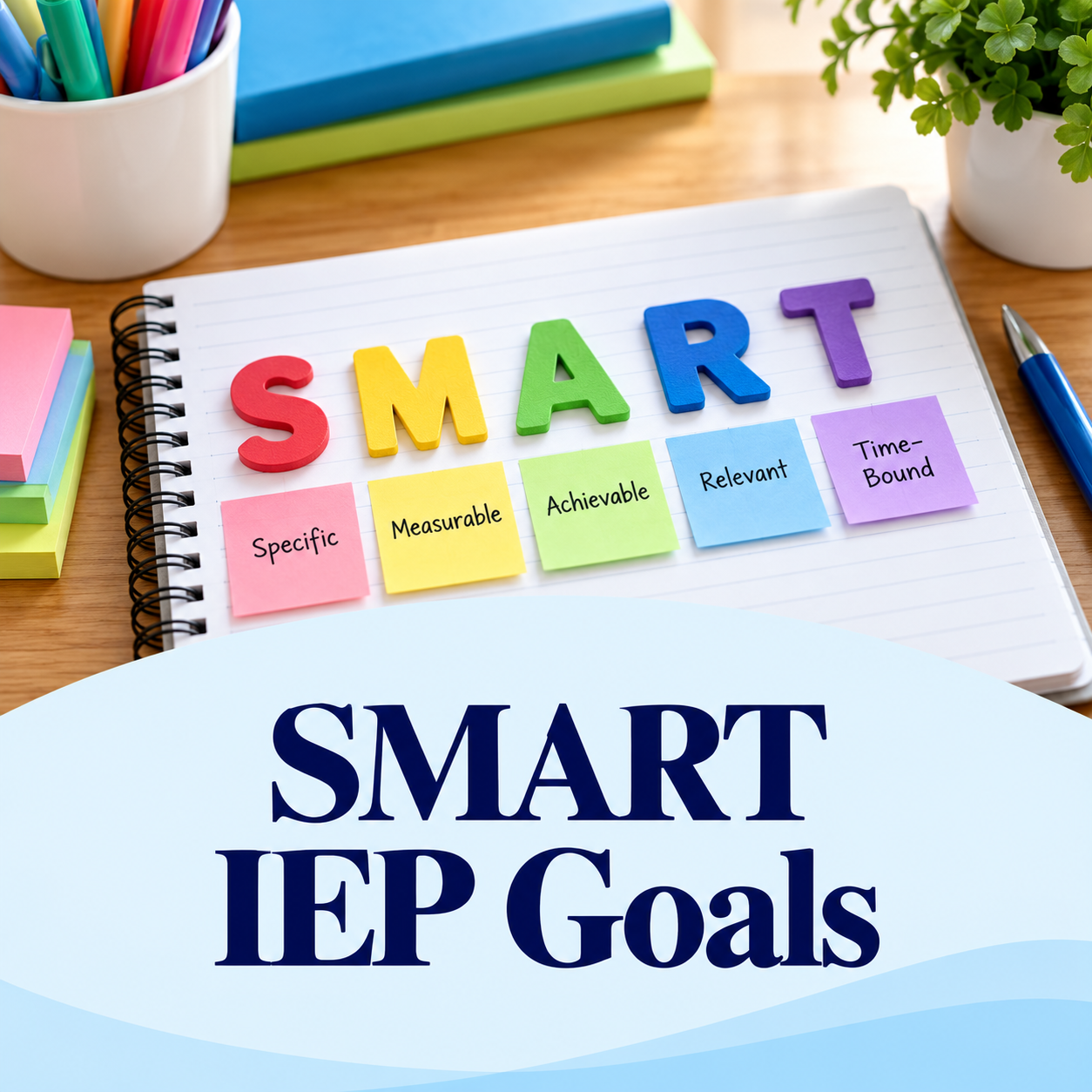
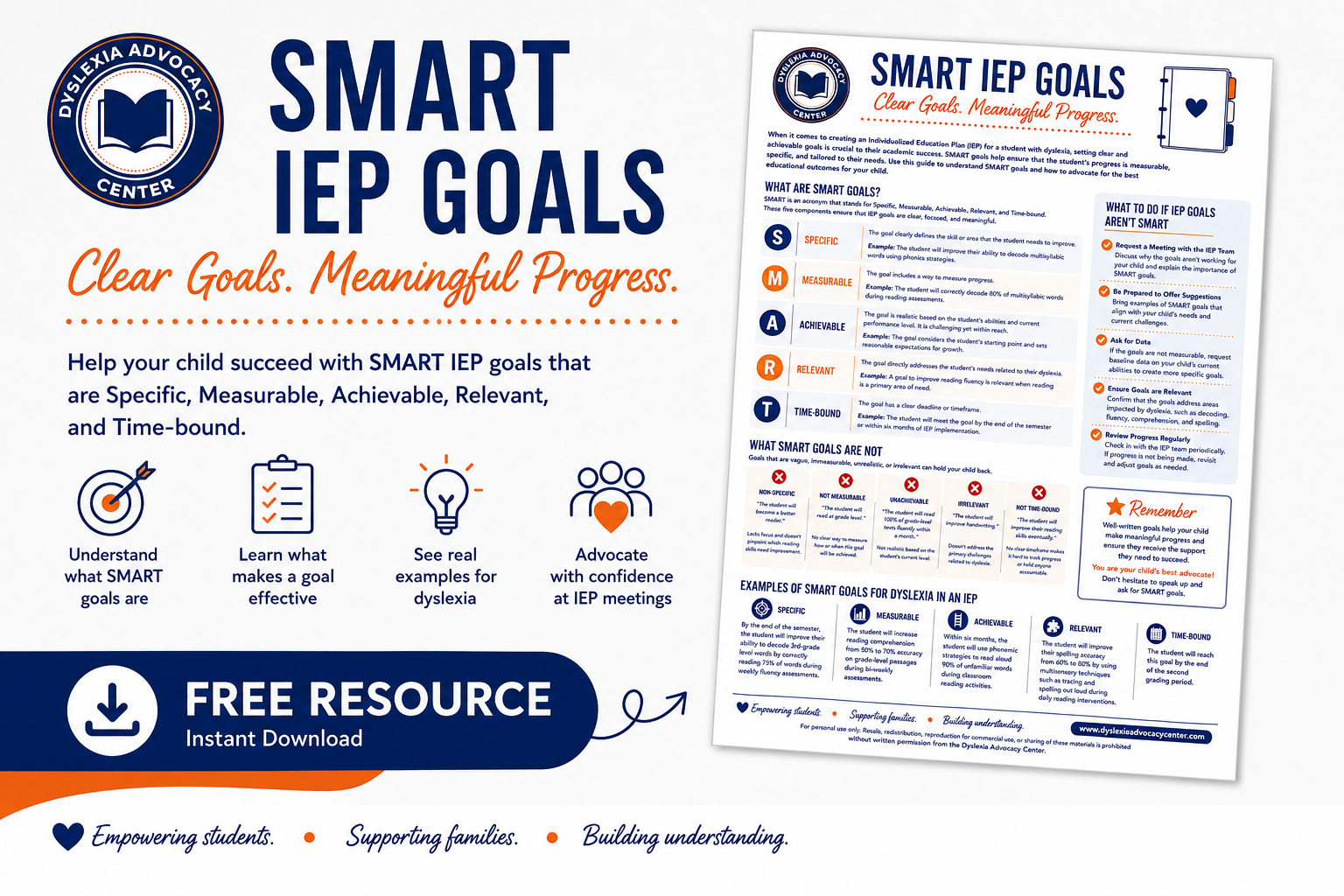
Well-written goals follow the SMART framework:
Specific: Clearly identifies the skill being addressed.
Measurable: Explains how progress will be measured.
Achievable: Sets a realistic expectation based on the student's current performance.
Relevant: Addresses an area of educational need.
Time-bound: Identifies when the goal should be achieved.
Consider the difference between these two goals.
Goal 1: The student will improve their reading skills.
Goal 2: Given a list of 20 unfamiliar, regularly spelled one-syllable words containing previously taught phonics patterns, the student will read at least 18 words correctly on three consecutive weekly assessments by the end of the IEP period, improving from a baseline of 10 correct words.
The second goal tells you much more. It identifies the skill, the starting point, the expected improvement, and how progress will be measured. When you receive progress reports, you can compare your child's performance against these expectations. If your child's IEP goals are vague or difficult to measure, consider asking the IEP team to review them. Without clear goals, it becomes much harder to determine whether instruction is effective. Learn more about SMART goals and download our free resource here.
Understanding Your Child's Progress Reports
Parents often receive IEP progress reports at the same time as regular report cards, although the reporting schedule is established in the IEP. These reports are intended to explain how your child is progressing toward their annual goals. Unfortunately, not all progress reports provide the same level of detail.
You might receive a report that says: "Making progress toward goal." or "Student continues to demonstrate improvement." While these statements sound positive, they don't explain how much progress has been made or whether your child is on track to meet the goal.
A useful progress report should help you understand:
Where your child started at the beginning of the IEP period.
What their current performance looks like.
How progress has been measured.
Whether they are on track to meet the annual goal.
Whether instruction or supports need to be adjusted.
For example, imagine your child has a reading goal involving decoding unfamiliar words. At the beginning of the year, they correctly read 10 out of 20 words. Their annual goal is to read 18 out of 20 correctly. A progress report showing that they now read 15 out of 20 words correctly gives you meaningful information. You can see the improvement and compare it with the expected outcome. But if the report simply says "progressing," you have no way of knowing whether your child is reading 11 words correctly or 17. Parents can and should ask for the actual data behind progress reports. This doesn't mean you need to challenge every report. It means asking for enough information to understand what the report is telling you.
Look at Progress Over Time, Not Just One Assessment
One assessment doesn't tell the whole story. Children can have good days and difficult days. They may perform differently depending on the task, their familiarity with the material, or how they are feeling. That's why progress monitoring should involve repeated measurements over time. For example, a school might measure a student's decoding accuracy weekly or assess reading fluency at regular intervals. The results can be placed on a graph to show whether the student is improving.
When reviewing progress, look for patterns. Is your child's performance steadily improving? Has progress slowed? Have scores remained about the same for several weeks? Is your child making progress, but not quickly enough to reach their annual goal?
A child may be improving and still not be making sufficient progress. For example, a student who begins the year reading 30 correct words per minute and increases to 35 has made progress. But if their goal is to reach 80 correct words per minute by the end of the year, the team needs to consider whether the current rate of improvement is sufficient. The goal is not simply to show that something has improved. It is to determine whether the child is making meaningful progress toward their educational goals.
Your Child's Feedback Matters Too
Progress monitoring shouldn't be limited to assessments and school reports. Your child can provide valuable information about how their supports are working. Children with Dyslexia know which parts of the school day are especially difficult. They may be able to tell you when reading feels overwhelming, which assignments take the most effort, or whether an accommodation is actually helping.
Make time to talk with your child about their experience.
You might ask:
Is reading getting easier, harder, or feeling about the same?
What is the hardest part of your school day right now?
Are you getting the help you need when you have to read or write?
Do you feel comfortable using your accommodations?
Is there something your teacher does that makes learning easier?
Is there anything you wish your teachers understood about how you learn?
Pay attention to what your child says, but also to what you notice. Maybe your child used to become frustrated every evening during homework, but now they can complete reading assignments with less support. Perhaps they are more willing to read independently or are starting to recognize words that previously caused difficulty. Those changes matter.
On the other hand, if your child is spending hours on homework, avoiding reading, or becoming increasingly frustrated, those experiences deserve attention even if their grades look fine. A child may be working extremely hard to maintain passing grades without making the progress they need.
Academic data and your child's personal experience should both be part of the conversation. Your child's feedback doesn't replace formal progress monitoring, but it can help the team understand whether skills and supports are making a difference in everyday situations.
Are Accommodations Actually Helping?
For students with Dyslexia, accommodations can play an important role in accessing classroom instruction and demonstrating what they know. Common accommodations include extended time, text-to-speech technology, audiobooks, speech-to-text tools, and access to written directions. But accommodations should be reviewed just like other educational supports. For example, your child may have access to text-to-speech software, but are they actually using it? Do they know how to operate it independently? Is it available in all the classes where they need it?
Sometimes an accommodation looks appropriate on paper but isn't being implemented consistently. Other times, the accommodation is available, but the student doesn't find it helpful. Talk with your child and their teachers about what is working. It is also important to remember that accommodations and specialized instruction serve different purposes.
Accommodations help students access learning and demonstrate their knowledge without unnecessary barriers. Specialized instruction teaches the skills they need to develop. A student with Dyslexia may benefit from audiobooks while also receiving structured literacy instruction to improve decoding and word recognition. One doesn't replace the other.
If your child has a 504 Plan rather than an IEP, reviewing how accommodations are being implemented is especially important. A 504 Plan generally doesn't include the same measurable annual goals and progress-reporting requirements as an IEP, but parents can still request information about how well accommodations are meeting their child's needs.
What Should You Do if Your Child Isn't Making Progress?
Discovering that your child isn't making expected progress can be discouraging, especially when they are receiving services and working hard. But identifying a lack of progress is one of the reasons progress monitoring exists. It gives the educational team an opportunity to make changes rather than continuing with an approach that isn't producing the expected results.
Start by asking the school to review the data with you. Find out which skills are improving, where progress has slowed, and what instructional approaches are being used. For a child with Dyslexia, questions might include whether instruction is sufficiently explicit and systematic, whether it addresses the child's identified reading needs, and whether the frequency and intensity of instruction are appropriate. You can also ask whether the team has considered adjustments to the instructional approach, additional practice, different materials, or changes in service delivery.
Sometimes the solution involves a relatively small adjustment. Other times, the IEP team may need to consider more significant changes. Parents do not have to wait until the annual IEP meeting to raise concerns. You can request an IEP team meeting when you believe your child's progress or educational needs should be reviewed. The important thing is not to wait months while your child continues to struggle without examining what needs to change.
Questions Parents Can Ask at an IEP Meeting
You don't need to arrive at an IEP meeting with an understanding of every assessment or educational term.
A few focused questions can help you get the information you need.
What was my child's starting point for each IEP goal?
How are you measuring progress, and how often?
Can you show me the actual data or progress-monitoring graph?
Is my child on track to meet their annual goals?
What changes have you made when the data showed limited progress?
How do you know the reading instruction is addressing my child's specific needs?
Are my child's accommodations being used consistently across classes?
What can I look for at home that would indicate these skills are improving?
How is my child's feedback about learning being considered?
When will we review progress again?
You may not need to ask every question. Choose the ones that relate most closely to your child's needs and the information you already have. If something isn't clear, ask for an explanation. You should leave the meeting understanding what your child is working on, how they are doing, and what happens next.
Keep Your Own Record of Progress
One simple way to stay involved is to keep a record of your child's progress throughout the school year. You don't need a complicated tracking system.
A folder, notebook, or digital document can help you organize information such as:
IEP goals and progress reports.
Reading assessments and work samples.
Emails or updates from teachers.
Notes from IEP or 504 meetings.
Your child's feedback about school.
Questions or concerns you want to discuss with the team.
You might also save a writing sample from the beginning of the school year and compare it with one completed several months later. These examples can help you recognize changes that may not be obvious from a report card. Keep in mind that work samples and observations supplement formal progress-monitoring data. They are useful pieces of information, but they don't replace consistent measurement of specific skills. Having information organized also makes it easier to participate in meetings, identify patterns, and follow up on concerns.
Dyslexia Advocacy Center has several resources to help you organize all of these documents. Visit our shop to learn more.
Progress Is About More Than Grades
For children with Dyslexia, progress can take different forms. It may mean learning to decode unfamiliar words more accurately, spelling more independently, or becoming more fluent when reading connected text. It can also mean learning to use assistive technology, understanding when to ask for help, or becoming more comfortable advocating for accommodations. These skills can have a meaningful impact on a child's school experience.
Still, it is important to distinguish between feeling more successful in school and developing the academic skills identified in the IEP. Both matter, and both deserve attention. A child who feels more confident using an audiobook may be accessing classroom material more successfully. That is valuable. But if the child also has a decoding goal, the school should continue measuring whether their decoding skills are improving. Looking at the full picture helps parents and educators understand what is working and where additional support may be needed.
Staying Involved in Your Child's Progress
Progress monitoring isn't about expecting your child to improve every single week or questioning every decision the school makes. It's about making sure there is a clear understanding of your child's needs, measurable expectations for improvement, and a process for recognizing when something isn't working. Review your child's IEP goals. Read the progress reports. Ask for data when the information is unclear. Talk with your child about their experience and share what you notice at home.
Most importantly, don't assume that services are effective simply because they are being provided. The question isn't just whether your child is receiving support. It's whether that support is helping them learn, develop skills, and make meaningful progress. When parents understand progress monitoring and participate in the process, they are better prepared to work with the school team, ask informed questions, and advocate for changes when their child needs them.