Special Education & Dyslexia Glossary: 267 Terms Parents Should Know
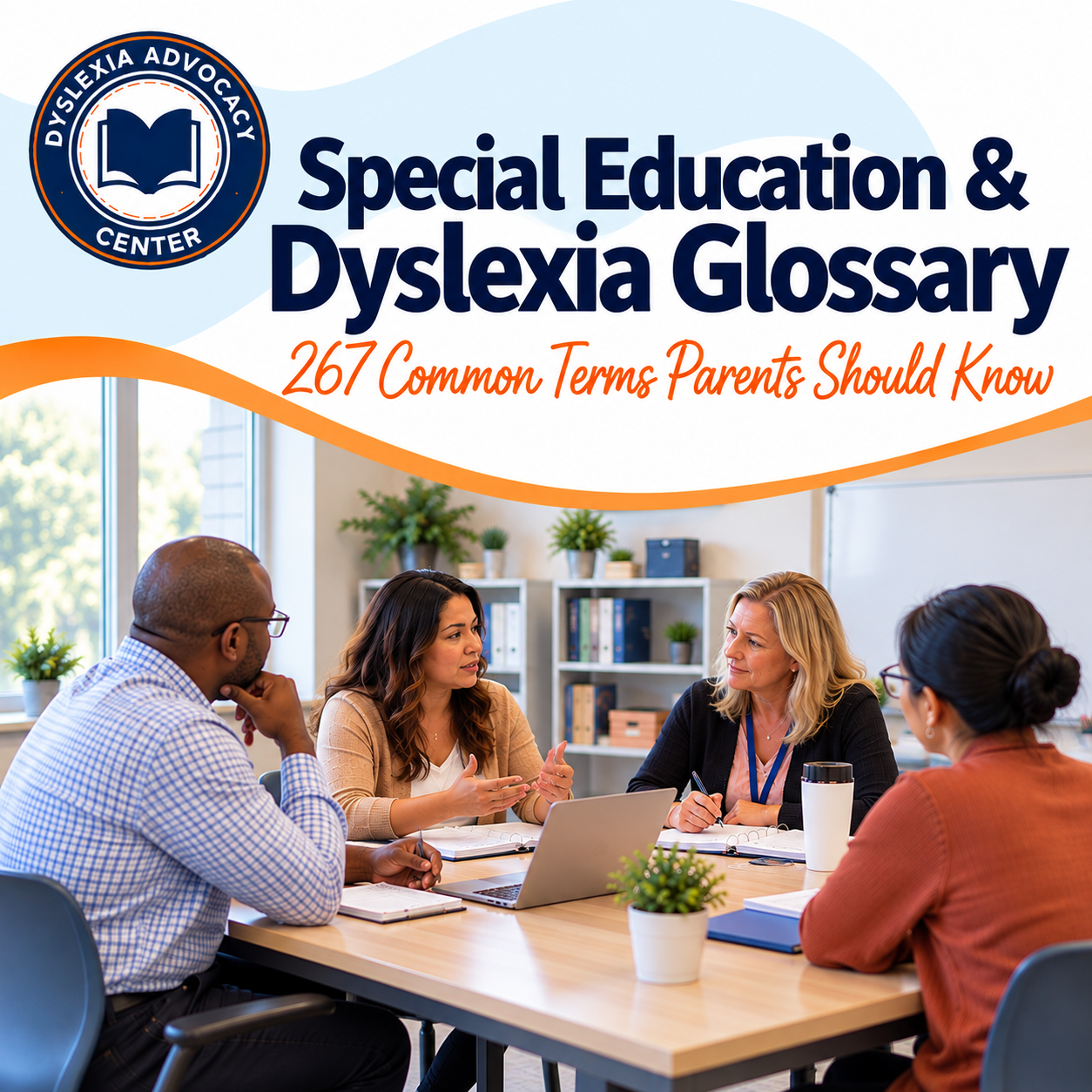
Special education has its own language. If you are new to the process, it can sometimes feel like everyone around the table already knows what the acronyms, test scores and educational terms mean. IEP. FAPE. LRE. SLD. Phonological awareness. Orthographic mapping. Standard scores. Related services. Progress monitoring.
Parents may hear several of these terms during a single meeting, see them throughout an evaluation or find them written into an IEP without much explanation. That is why we created the Special Education & Dyslexia Glossary, a free, parent-friendly resource with 267 commonly used terms and definitions related to dyslexia, reading, evaluations, special education, school supports and transition.
While some of the terms are directly related to Dyslexia and reading, this glossary goes much further. It includes a wide range of special education terms you may encounter during your child's education, along with others you may not have come across yet but may find helpful to understand.
The goal is to make the language easier to understand so you can follow the conversation, ask questions and participate more confidently in decisions about your child's education.
What's Included in the Glossary?
Rather than putting hundreds of terms into one long alphabetical list, the glossary is organized by topic. This makes it easier to find related information and understand how different terms connect.
Dyslexia, Learning & Neurodevelopmental Terms
This section includes terms you may encounter when learning about dyslexia and other learning or developmental differences.
You'll find definitions for terms such as dyslexia, dysgraphia, dyscalculia, Specific Learning Disability (SLD), executive dysfunction, twice exceptional (2e), ADHD, developmental delay and more.
These terms may appear in evaluations, school reports, medical documentation or conversations with professionals.
Reading, Writing & Structured Literacy
Reading instruction comes with its own vocabulary, and understanding some of these terms can be especially helpful when your child is struggling to read.
This section explains concepts including:
Phonological awareness
Phonemic awareness
Phonics
Decoding
Encoding
Orthographic mapping
Fluency
Reading comprehension
Structured literacy
Explicit instruction
Systematic instruction
Morphology
Automaticity
Science of Reading
Understanding these terms can help you have more informed conversations about what your child is being taught—not simply whether they are receiving "reading help."
For example, decoding and encoding sound similar but describe different skills. Decoding involves using knowledge of letters and sounds to read words, while encoding involves translating sounds into written words and is an important part of spelling.
Knowing the difference can help you better understand an evaluation or ask more specific questions about instruction.
Special Education Law, Rights & the IEP Process
Special education meetings often include acronyms and legal terminology that families may not use anywhere else.
The glossary includes parent-friendly explanations of terms such as IDEA, FAPE, LRE, Section 504, Child Find, procedural safeguards, prior written notice, due process, mediation, eligibility, placement, reevaluation and transition planning.
You don't need to memorize all of these terms.
Instead, use the glossary as a reference when something unfamiliar comes up. If someone mentions FAPE during an IEP meeting, for example, you can quickly look up what it means and why it matters.
IEP Components, Services & Supports
An IEP contains much more than goals. There are terms related to instruction, accommodations, services, placement and how support is provided throughout the school day.
The glossary explains concepts such as present levels of performance, annual goals, baseline data, specially designed instruction, related services, supplementary aids and services, accommodations, modifications, assistive technology, push-in services, pull-out services, co-teaching and specialized transportation.
One distinction that is particularly important for parents to understand is the difference between an accommodation and a modification. An accommodation changes how a student accesses information or demonstrates learning without changing the learning expectation. A modification changes what the student is expected to learn or demonstrate. They aren't interchangeable terms, and understanding the difference can be important when reviewing your child's educational plan.
Evaluations & Testing
Educational evaluations can be some of the most difficult documents to understand. They often contain assessment terminology that isn't familiar to most people outside of education or psychology.
The glossary explains terms including standard score, percentile rank, scaled score, confidence interval, standard deviation, norm-referenced assessment, criterion-referenced assessment, comprehensive evaluation, psychoeducational evaluation, classroom observation and more. These definitions can be useful when you're reviewing an evaluation before a meeting. One important example is percentile rank. A percentile rank is not the same thing as a percentage correct on a test. Understanding that distinction can completely change how a score is interpreted.
Instructional Strategies & Learning Supports
You'll also find terms describing different ways educators may teach or support students. These include scaffolding, differentiation, task analysis, prompting, visual supports, graphic organizers, chunking, flexible grouping, retrieval practice, video modeling, Universal Design for Learning (UDL) and more. Knowing what these terms mean can help you move beyond simply hearing that your child will "receive support."
You can ask more specific questions:
What will that support actually look like?
Who will provide it?
How often will it happen?
Will it occur in the classroom or somewhere else?
How will we know whether it is helping?
Behavior, Regulation, Sensory & Communication
Learning doesn't happen in isolation. Communication, sensory processing, emotional regulation, motor skills and behavior can all affect a student's experience at school. This section includes terms such as self-regulation, co-regulation, sensory processing, sensory overload, interoception, proprioception, replacement behavior, Functional Behavioral Assessment (FBA), Behavior Intervention Plan (BIP), AAC, occupational therapy, physical therapy and speech-language pathology.
Inclusion, Family Partnership & Transition
As students get older, conversations begin to expand beyond what is happening in the classroom today. The glossary includes terminology related to self-advocacy, self-determination, person-centered planning, postsecondary goals, vocational training, community-based instruction, independent living skills, supported employment, job coaching and other aspects of transition. These terms can help families understand the transition process and begin asking questions about life after high school.
How to Use the Glossary
You don't need to sit down and read all 267 definitions at once. Think of the glossary as a resource you can return to whenever you need it. Download it and save a copy on your phone, computer or tablet. You may also want to print a copy and keep it with your child's IEP/504 binder.
It can be especially helpful to have available when you are:
Reviewing an evaluation
Preparing for an IEP or 504 meeting
Reading an IEP
Looking at progress reports
Reviewing proposed accommodations or services
Preparing questions for your child's school
Learning about reading instruction
Beginning transition planning
Talking with teachers, specialists or evaluators
Download the Free Special Education & Dyslexia Glossary
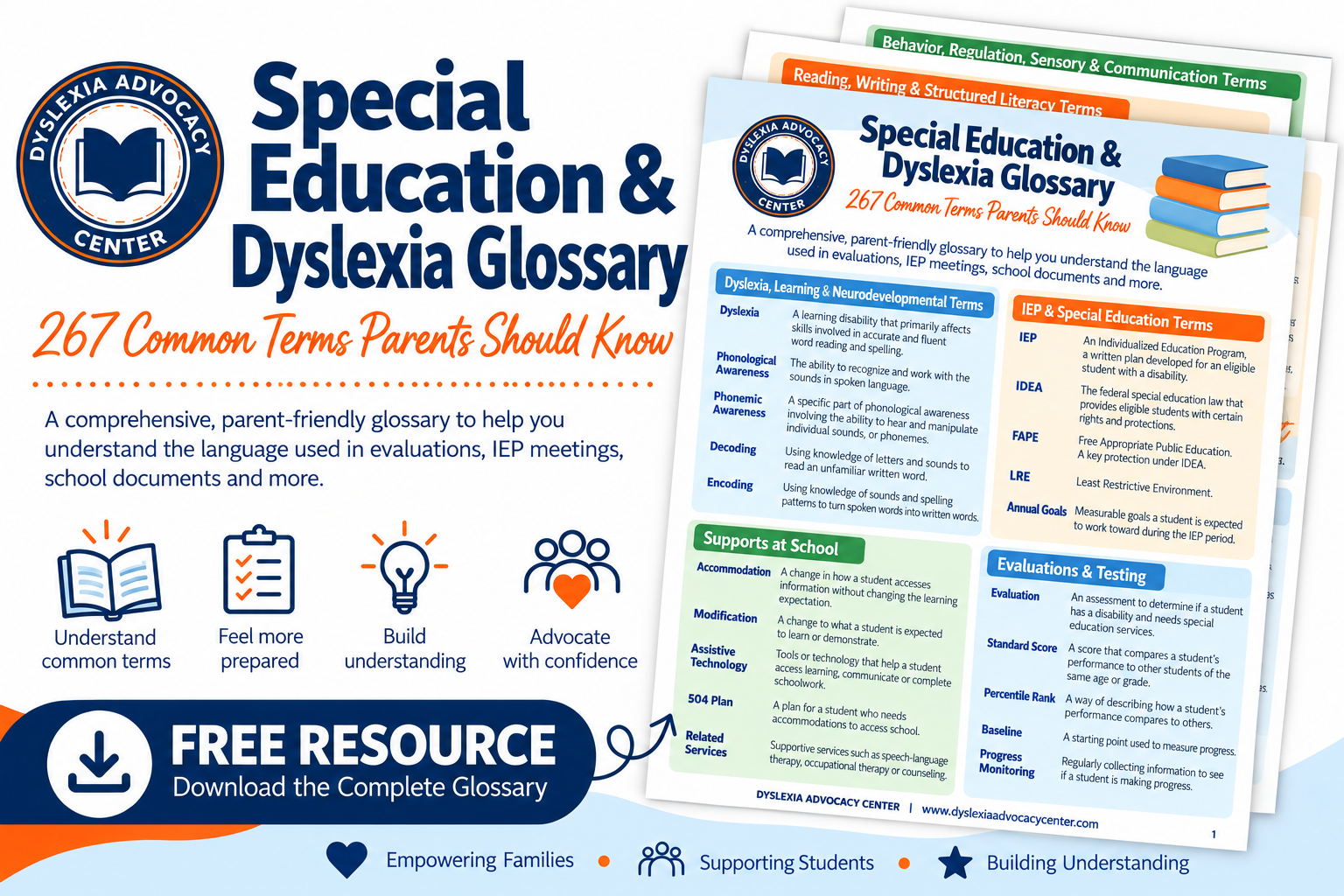
The Special Education & Dyslexia Glossary includes 267 parent-friendly definitions in one downloadable resource.
Enter Your Email Address & Download the FREE Special Education & Dyslexia Glossary
Understanding the language is one part of understanding the process. And when you better understand what is being discussed, you are better prepared to ask questions, participate in decisions and advocate for the support your child needs.