
How to Be Your Own Advocate

You probably know more about how you learn than you realize. You know which assignments take you longer than other students. You know when you're having trouble following directions, when reading feels overwhelming, or when you understand an answer but can't seem to get it onto paper.
You also know when something helps. Maybe listening to a book makes it easier to understand. Maybe you do better when a teacher shows you an example. Or perhaps having a little extra time means you can finish a test without rushing.
These are important things to know about yourself. Learning how to explain what works for you, what doesn't, and what support you need is called self-advocacy. It's a skill you can develop and use throughout school, college, work, and everyday life.
What Is Self-Advocacy?
Self-advocacy means understanding your needs and being able to communicate them to other people. At school, this might mean telling your teacher when you don't understand something, asking to use an accommodation, or explaining why a particular assignment is difficult. You don't have to know exactly what to say every time. You also don't have to feel comfortable speaking up right away.
Self-advocacy takes practice. You can start with something small, like asking a teacher to repeat directions or explain a question another way. Over time, you can learn to have bigger conversations about your Dyslexia, your accommodations, and what helps you learn.
Start by Understanding What Works for You
Everyone with Dyslexia has different strengths and challenges. You might find reading difficult but enjoy participating in class discussions. You might be good at explaining your ideas out loud but struggle to write them down. You might understand your homework but need more time to complete it.
Think about your typical school day.
When does learning feel easier?
When someone explains information out loud?
When you can listen to a book instead of reading it independently?
When you see an example before starting an assignment?
When directions are broken into smaller steps?
When you can type instead of handwriting?
When you have more time to finish your work?
When you work somewhere with fewer distractions?
Now think about what makes school difficult. Maybe copying notes from the board takes so long that you miss what the teacher is saying. Maybe you understand a science lesson but struggle to read the test questions. Maybe spelling makes it hard to write everything you want to say. These are things worth sharing with your teachers. You don't need to know how to solve every problem. Being able to explain what is difficult is a good place to start.
For example, instead of saying, "I can't do this assignment," you might say: "I understand what we're learning, but I'm having trouble reading all the directions. Can we go through them together?" That gives your teacher more information about what you need.
Understand Your Accommodations
If you have an Individualized Education Program (IEP) or a 504 Plan, you may have accommodations to help you access learning at school. Accommodations are supports that help you access learning, complete your schoolwork, and demonstrate what you know without changing what you are expected to learn. They don't mean you're getting easier work or that someone is giving you the answers.
For example, imagine your class is taking a history test. You understand the history, but reading the questions takes you longer because of your Dyslexia. If your plan allows extended time, you may have additional time to finish the test. You're still answering the same history questions. You just have the time you need to read and respond. Accommodations help remove barriers that might otherwise make it difficult for you to demonstrate what you've learned.
Common Accommodations for Students with Dyslexia
Extended time: You may receive additional time to finish tests or assignments. This can help if reading, spelling, or writing takes you longer.
Text-to-speech: Technology reads written information aloud. This can help you access textbooks, articles, directions, and other reading assignments.
Speech-to-text: You speak your ideas, and technology turns them into written words. This can be helpful when you know what you want to say but struggle to write or spell it.
Audiobooks: You listen to a book rather than relying only on reading printed text. This can help you participate in classroom reading assignments and discussions.
Teacher-provided notes: You may receive copies of notes or an outline of the lesson. This can help you focus on listening and understanding instead of trying to copy everything from the board.
Reduced-distraction setting: You may complete certain assignments or tests in a quieter environment.
Graphic organizers: You use a visual outline or planning tool to organize ideas before writing.
Directions read aloud or explained: Your teacher may read directions with you or explain them in smaller steps when appropriate.
Not every student has all these accommodations. The supports you receive should be based on your individual needs. If you have an IEP or 504 Plan, ask a parent, teacher, counselor, or case manager to review it with you. You should understand which accommodations are included, when you can use them, and how to access them.
Learn How to Ask for What You Need
Sometimes the hardest part of self-advocacy is knowing what to say. You might worry that your teacher is busy, that other students will notice, or that you should already understand the assignment. You don't need to give a long explanation. A simple, specific request is often enough.
If You Don't Understand the Directions
Instead of sitting quietly and guessing, try:
"Can you please explain the directions another way?"
"Can you show me an example of what the finished assignment should look like?"
"Can we go through the first question together?"
If You Need More Time
Try:
"I have extended time in my plan. How will that work for this test?"
"I'm still working on the assignment. Can we talk about how I can use my extra time?"
If You're Having Trouble Reading
Try:
"Can I use text-to-speech for this assignment?"
"Is there a digital copy I can listen to?"
"Can you read the directions with me?"
If You're Having Trouble Writing
Try:
"Can I type my response instead of writing it by hand?"
"Can I use speech-to-text to get my ideas down?"
"Could I use a graphic organizer before I start writing?"
If You're Having Trouble Concentrating
Try:
"Can I move to a quieter place to finish this?"
"I'm having trouble focusing with the noise. Is there another place I can work?"
If You're Feeling Overwhelmed
Try:
"Can we break this assignment into smaller steps?"
"I'm not sure where to start. Can you help me figure out the first step?"
These requests help your teacher understand the specific support you're asking for.
You can also write your question in an email or message if speaking face-to-face feels uncomfortable.
What If You Know Something Isn't Working?
Sometimes a strategy that helped you last year doesn't work as well this year. Maybe your classes have become more difficult. Maybe assignments are longer. Or perhaps you have a new teacher who doesn't yet understand how your Dyslexia affects you. It's important to pay attention when something isn't working.
For example, imagine you have text-to-speech available, but your teacher posts reading assignments as scanned worksheets that the software cannot read.
You might say:
"I'm supposed to be able to use text-to-speech, but it isn't working with this worksheet. Is there another version I can use?"
Or maybe you're receiving extra time on tests, but you're still struggling to finish because the reading demands are so high.
You could say:
"I'm using my extra time, but I'm still having trouble finishing. Can we talk about what's making the test difficult?"
You know what you're experiencing. Your feedback matters when adults are deciding how to support you. You don't have to wait until your grades drop or you fail an assignment to explain that something isn't working. And you don't have to figure out the solution alone.
What If Your Accommodations Aren't Being Provided?
If you have an IEP or 504 Plan, the school is responsible for providing the accommodations required by your plan. You can help by understanding what is included and letting someone know when a support isn't available.
For example, if you're taking a test and realize you haven't been given your extended time, you might say:
"My plan includes extended time. Can you tell me how I'll receive that today?"
If a teacher says you cannot use an accommodation that is included in your plan, you can ask to speak with your special education teacher, case manager, counselor, or 504 coordinator. You can also tell a parent or another trusted adult.
You might say:
"I wasn't able to use my text-to-speech accommodation in class today. Can you help me figure out what happened?"
Remember, you are learning to speak up for yourself, but you are not responsible for making sure the school follows your IEP or 504 Plan. Adults at school are responsible for providing your required supports. Self-advocacy helps you participate in the process and communicate when you need assistance.
Speak Up During Your IEP or 504 Meetings
If you have an IEP or 504 Plan, you may be invited to participate in meetings about your education. These meetings are opportunities for the adults supporting you to discuss your progress, accommodations, and educational needs. You don't have to understand every educational term or know everything about the process. You can begin by sharing what school is like from your perspective.
For example:
"I understand the material better when I can listen to it."
"Taking notes while the teacher is talking is hard for me."
"Speech-to-text helps me finish writing assignments."
"I don't like leaving class for tests. Can we talk about other options?"
"Math is going well, but I'm having trouble keeping up with reading in history."
"I want to learn how to use my accommodations more independently."
You can also share things you're proud of, classes you enjoy, and goals you want to work toward. If attending a meeting feels intimidating, ask a parent, teacher, or counselor to help you prepare. You could write down a few things you want the team to know and read them during the meeting. You might even choose to share your thoughts in writing instead of speaking. Your perspective is an important part of understanding whether your educational supports are working.
What to Do When You're Stuck
Everyone gets stuck sometimes. When an assignment feels difficult, it can be tempting to stop working, guess at the answers, or avoid the task. Having a plan can help.
Try these four steps:
STOP: Take a moment before deciding what to do next.
THINK: Ask yourself what part of the assignment is difficult.: Are you having trouble reading the directions? Understanding the question? Organizing your ideas? Getting started?
ASK: Tell your teacher what part is confusing and what you need help with. Instead of saying, "I don't get it," try, "I understand the first step, but I'm not sure what to do after that."
TRY AGAIN: Use the support or strategy that helps you and continue working. Sometimes you may need to ask another question or try a different approach.
The important thing is to recognize when you need support and know how to get it.
Practice Self-Advocacy in Small Ways
You don't have to start by speaking at an IEP meeting or having a long conversation with a teacher. Start with something manageable.
This week, you might decide to:
Ask a question when you don't understand the directions.
Use your text-to-speech tool during an assignment.
Tell a teacher which strategy helped you.
Ask for an example before beginning a writing assignment.
Review your accommodations with a trusted adult.
Send a teacher an email about something you're finding difficult.
Choose one thing to practice. Afterward, think about what happened. Did you get the support you needed? Was it easier or harder than you expected? Would you say something differently next time? Each experience helps you learn how to communicate your needs.
Self-Advocacy Is a Skill You'll Use Beyond School
Learning how to explain what you need is useful long after you finish school. In college, you may need to contact the disability services office to arrange accommodations. At work, you may need to explain which tools help you complete certain tasks. In everyday life, you might use text-to-speech to read documents, ask someone to provide written instructions, or use speech-to-text to communicate. The situations will change, but the skills you develop now can continue to help you. You can learn to recognize challenges, identify helpful tools, ask questions, and communicate what you need.
Having Dyslexia means some parts of learning may be more difficult for you. It doesn't mean you should have to manage those difficulties without support. You deserve access to the tools, accommodations, and instruction you need to participate in school. Your teachers and other adults can help, but they may not always know what you're experiencing unless you tell them. You know when an assignment is taking much longer than expected. You know when a strategy is helping. You know when something isn't working.
That information is valuable. Start by learning about your Dyslexia and your accommodations. Practice asking questions. Share what helps you and speak up when something needs to change. You don't have to do everything on your own, and you don't have to get every conversation right. Self-advocacy starts with understanding what you need and learning how to communicate it. The more you practice, the more prepared you'll be to take an active role in your education and decisions about your future.
Use Our Student Self-Advocacy Worksheet
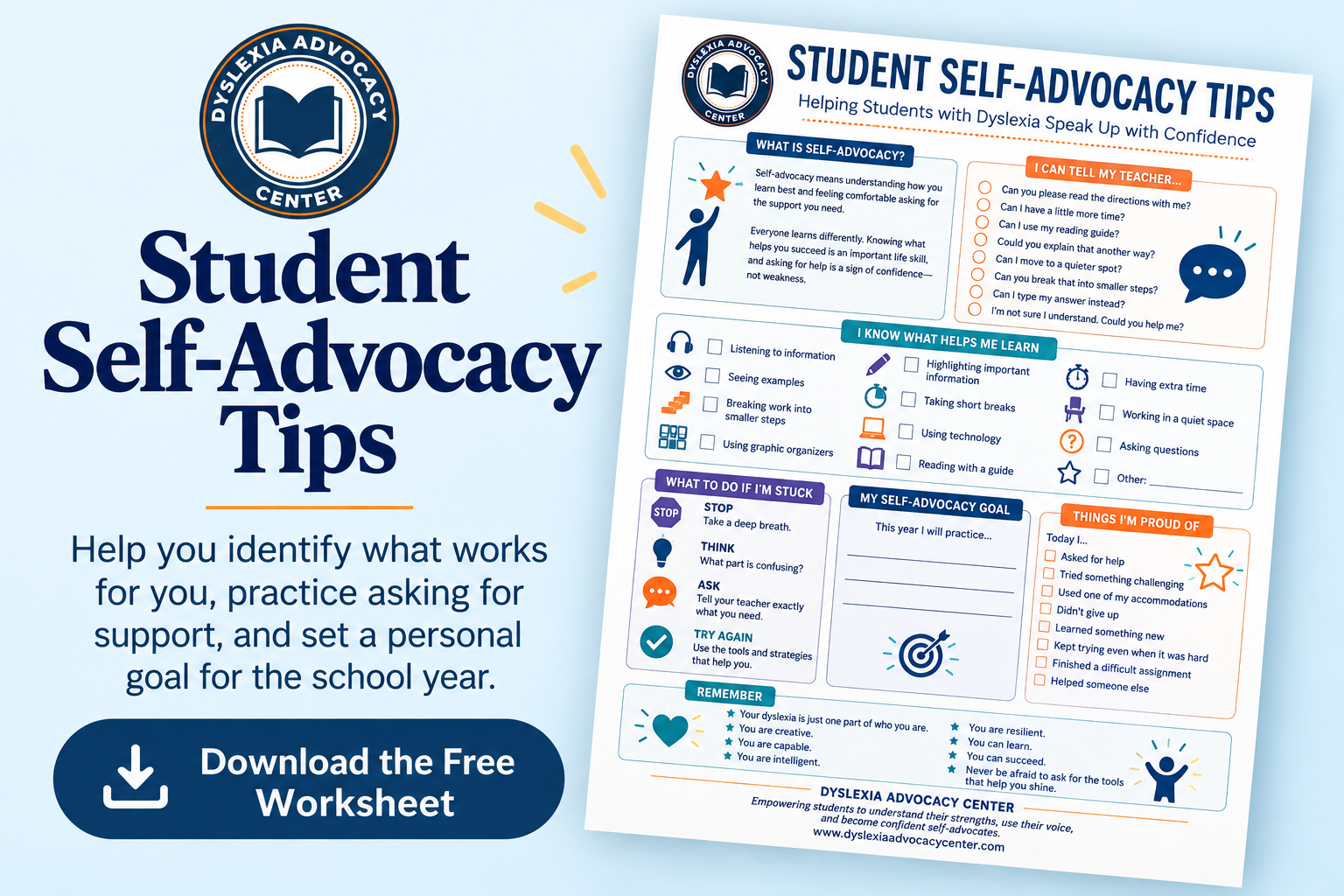
The Dyslexia Advocacy Center has created a free Student Self-Advocacy Tips worksheet to help you identify what works for you and practice asking for support. The worksheet includes several activities you can complete independently or with help from a parent, teacher, or counselor.
I Know What Helps Me Learn: Check off strategies that help you, such as listening to information, seeing examples, using technology, taking breaks, or having extra time.
I Can Tell My Teacher: Find examples of questions and requests you can use when you need help.
What to Do If I'm Stuck: Practice the STOP, THINK, ASK, and TRY AGAIN steps.
My Self-Advocacy Goal: Choose one way you want to practice speaking up for yourself this school year.
Things I'm Proud Of: Recognize your efforts and accomplishments, including asking for help, trying something challenging, using an accommodation, or finishing a difficult assignment.
You can complete the worksheet at the beginning of the school year, before an IEP or 504 meeting, or anytime you want to think about what is helping you learn.
Download: Student Self-Advocacy Tips
Enter your email address to download the worksheet. Use it to identify your learning preferences, practice asking for support, and set a personal self-advocacy goal.