
Accommodations in the Classroom: Helping Students with Dyslexia Access Learning
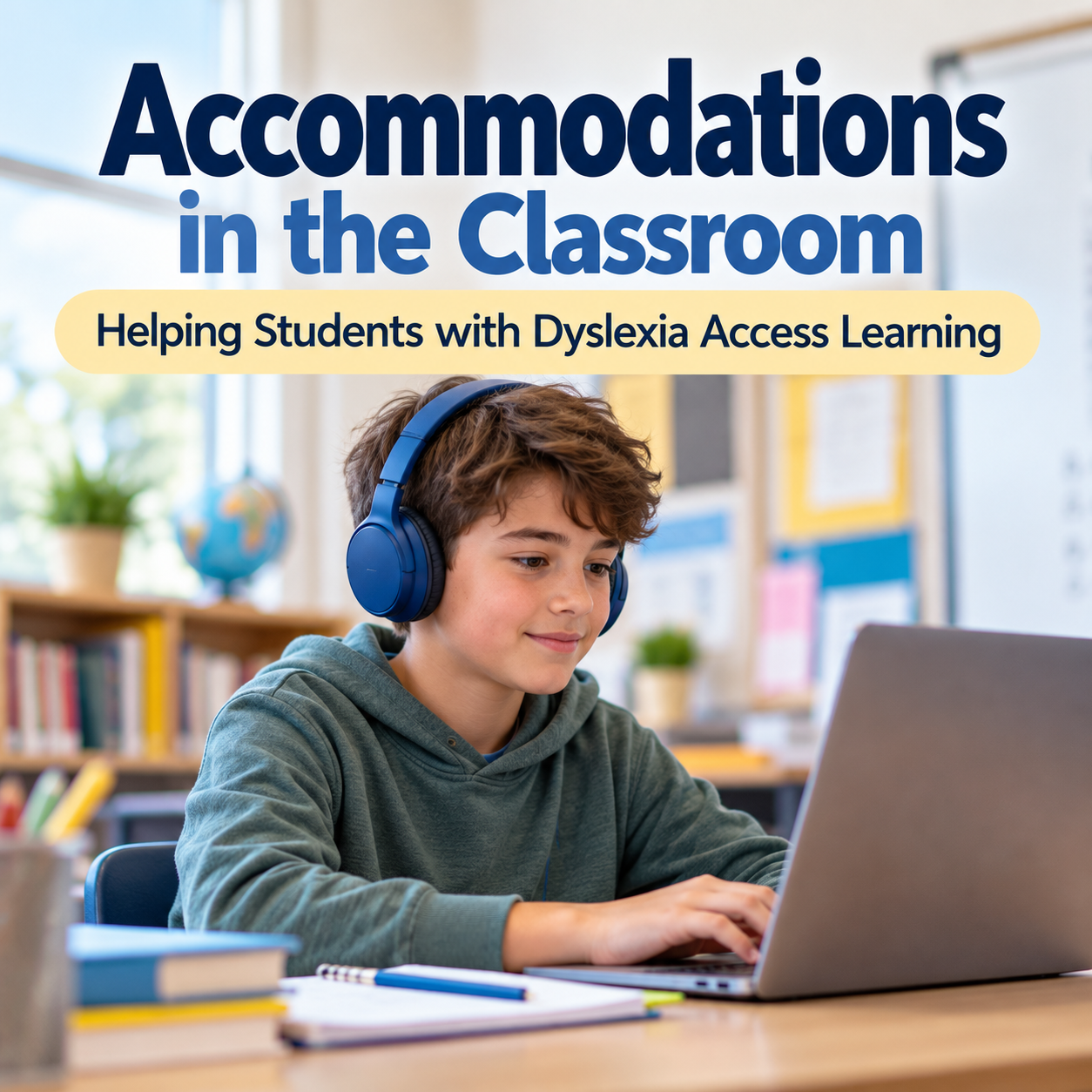
Imagine two students taking the same history test. Both understand the material and can explain the important events during classroom discussions. One student reads the questions and completes the test in 30 minutes. The other student has Dyslexia and needs more time to read the questions and organize written responses.
If the second student receives extended time or uses approved text-to-speech technology, is that cheating? No. Both students are being assessed on their understanding of history. The accommodation helps ensure that difficulty with reading does not prevent one student from demonstrating what they know.
Accommodations are not cheating. They help level the playing field so students with disabilities can access the curriculum and demonstrate their knowledge.
Understanding accommodations is important, but knowing how to implement them is just as important. A student may have accommodations listed in an Individualized Education Program (IEP) or Section 504 Plan, but those supports only help when they are consistently available during the school day.
For teachers, this means planning how accommodations will be provided during lessons, assignments, homework, and assessments.
For parents, it means understanding what accommodations should look like in practice and knowing what questions to ask when a child continues to struggle.
What Are Classroom Accommodations?
Accommodations are changes to how a student accesses information, participates in instruction, or demonstrates knowledge. They do not change the academic standards or what the student is expected to learn.
For example, a student with Dyslexia may understand grade-level science but have difficulty independently reading a lengthy textbook chapter. Providing an accessible digital textbook with text-to-speech allows the student to learn the same science concepts as classmates. The curriculum has not changed. The student simply has another way to access it.
Accommodations generally fall into four categories:
Presentation: Changes to how information is provided, such as text-to-speech, audiobooks, or accessible written directions.
Response: Changes to how a student demonstrates knowledge, such as typing, speech-to-text, or approved oral responses.
Setting: Changes to the learning or testing environment, such as a reduced-distraction location.
Timing and Scheduling: Changes to when or how long a student has to complete tasks, such as extended time or scheduled breaks.
Not every student with Dyslexia needs the same accommodations. The appropriate supports depend on the student's individual needs, the task, and what is being measured.
To learn more about the different types of accommodations and how they differ from modifications, read our article IEP Accommodations for Dyslexia.
Accommodations Are Not the Same as Modifications
This distinction is important for both teachers and parents. An accommodation changes how a student learns or demonstrates knowledge without changing the learning expectations. A modification changes what the student is expected to learn or the level of work required.
Example: Seventh-grade science
The class is learning about ecosystems.
An accommodation might allow a student to listen to the textbook chapter using text-to-speech and type responses instead of handwriting them. The student is still expected to understand the same science concepts.
A modification might change the assignment so the student is expected to learn fewer or less complex concepts.
Both may have a place in an individualized educational program, but they serve different purposes. It is also important to understand that shortening an assignment is not automatically a modification. Reducing repetitive questions while preserving the same learning objective may be an accommodation. Changing the learning objective itself is a modification.
Why Accommodations Need to Be Part of Everyday Instruction
A common misunderstanding is that accommodations are primarily for tests. In reality, many students need accommodations throughout the school day. Consider a student whose IEP includes text-to-speech. The student may need that support when reading a science article, completing a social studies worksheet, reviewing homework directions, or preparing for a test. If text-to-speech is only available during formal assessments, the student may struggle to access the instruction and assignments leading up to those assessments.
Accommodations should be available when the student's plan requires them, not only when the student is visibly struggling. A student should not have to fail an assignment, fall behind, or repeatedly ask for a documented accommodation before receiving it.
The following examples show how commonly used accommodations can be implemented during the school day.
1. Extended Time
Extended time is one of the most common accommodations for students with Dyslexia. Students who read slowly, need additional time to organize written responses, or use assistive technology may require more time to complete assignments and assessments.
What it looks like in the classroom
A student has an accommodation for 50% additional time on tests. The class has 40 minutes to complete a test. The student is allowed up to 60 minutes. However, simply telling the student they have extra time is not enough. The teacher needs to determine how the additional time will be provided. Will the student begin earlier? Continue during another period? Complete the test in an approved alternate location? These arrangements should be made before the assessment begins.
How teachers can implement it
Review the amount of extended time required by the student's plan.
Determine how the additional time will fit into the school schedule.
Arrange supervision and an appropriate location when needed.
Explain the plan privately to the student.
Make sure extended time is available for all activities covered by the accommodation.
What parents can ask
How is extended time provided during regular classroom tests?
What happens if the class period ends before my child finishes?
Does extended time apply to assignments and homework?
Does my child know how to access the additional time?
Extended time should be a planned support, not something a student must negotiate during every test.
2. Text-to-Speech and Audiobooks
Text-to-speech technology reads digital text aloud. Audiobooks provide recorded versions of written materials. These tools can help students access grade-level content when decoding difficulties interfere with comprehension.
What it looks like in the classroom
A sixth-grade student is assigned a chapter about ancient civilizations. The teacher provides an accessible digital version of the chapter. The student listens to the text while following along on the screen. Afterward, the student participates in the same discussion and answers the same content questions as classmates. The student is still learning the material. The accommodation changes how the information is accessed.
How teachers can implement it
Provide accessible digital versions of reading materials.
Confirm that documents work with the student's text-to-speech software.
Teach the student how to use the technology independently.
Allow headphones when appropriate.
Make accessible materials available before assignments begin.
Check that the accommodation works across different subjects and platforms.
What parents can ask
Are textbooks and reading assignments available in accessible formats?
Does my child know how to use the reading software?
Is the technology available for homework?
Are teachers providing digital materials that work with the software?
Text-to-speech may not be appropriate for every reading assessment. For example, if a test is specifically measuring independent decoding, reading the passage aloud could change what is being measured. Teachers should follow the student's plan and applicable assessment rules.
3. Speech-to-Text and Typing
Some students with Dyslexia can explain their ideas verbally but struggle to produce written responses. Spelling, sentence construction, and the effort required to write can make assignments take much longer than expected. Speech-to-text allows students to dictate responses using technology. Typing may also be helpful for students who have difficulty with handwriting or editing written work.
What it looks like in the classroom
An eighth-grade student is writing an essay about a novel. The student understands the story and can explain the characters' motivations during discussion but struggles to begin writing. The teacher allows the student to use speech-to-text to create a first draft. The student then reviews the transcription, organizes the paragraphs, and edits the work. The final assignment is evaluated using the same content expectations as classmates, with the student's documented accommodations applied.
How teachers can implement it
Provide access to approved speech-to-text or word-processing tools.
Teach students how to dictate and edit their work.
Allow students to plan responses using graphic organizers.
Provide a suitable environment for dictation.
Clarify which assignments allow these tools.
Ensure students have opportunities to practice before major assessments.
What parents can ask
Is speech-to-text available during classroom assignments?
Does my child have access to the same technology at home?
Has someone taught my child how to use it effectively?
Is there an appropriate place to dictate without disturbing classmates?
Access to technology is only the first step. Students also need instruction and practice to use it successfully.
4. Copies of Notes and Reduced Copying
For some students with Dyslexia, copying information from the board or taking notes while listening can be difficult. A student may spend so much time trying to write everything down that they miss the actual lesson.
What it looks like in the classroom
A high school history teacher is presenting a lesson about the Industrial Revolution. The student's accommodation provides access to teacher notes. Before class, the teacher shares an outline containing the main topics, important dates, and vocabulary. During the lesson, the student follows along and adds examples or additional information. The student can focus on understanding the material rather than trying to copy every word.
How teachers can implement it
Share presentation slides or lesson outlines.
Provide guided notes with important information already included.
Allow approved digital note-taking tools.
Avoid requiring lengthy copying from the board.
Provide important vocabulary before lessons.
Ensure notes are available in an accessible format.
What parents can ask
Are notes provided before or after class?
Does my child receive notes consistently across subjects?
Is my child expected to copy information that should already be provided?
Are teacher notes available when my child is absent?
Providing notes does not mean students cannot participate in note-taking. It means the student has access to the information needed to learn.
5. Breaking Assignments Into Smaller Steps
Long assignments with multiple directions can be overwhelming, particularly when students must manage substantial reading and writing demands. Breaking assignments into smaller sections can make it easier to begin, organize, and complete the work.
What it looks like in the classroom
A fourth-grade student receives an assignment to read a passage, identify the main idea, locate supporting details, and write a paragraph.
Instead of presenting the assignment as one large task, the teacher provides a numbered checklist:
Read or listen to the passage.
Identify the main idea.
Find two supporting details.
Complete the paragraph organizer.
Write your paragraph.
Review your work.
The student completes each step before moving to the next.
How teachers can implement it
Divide longer assignments into smaller sections.
Provide written directions in a numbered format.
Use checklists to help students track progress.
Model the first step before independent work.
Establish checkpoints for longer projects.
Provide examples of completed assignments.
What parents can ask
Are assignments broken into manageable steps?
Does my child understand what needs to be completed first?
Are directions available online?
Are long-term projects divided into smaller deadlines?
These strategies can benefit many students, but they are particularly important when included in a student's documented accommodations.
6. Read-Aloud Accommodations
A read-aloud accommodation allows eligible written information to be read to the student by a person or approved technology. The exact scope depends on the student's plan and the purpose of the assignment or assessment.
What it looks like in the classroom
A student is taking a science test about the solar system.
The test measures understanding of planets, orbits, and scientific concepts.
The student's plan allows test questions to be read aloud when the assessment is not measuring independent reading.
The student receives the approved reading support and answers the same science questions as classmates.
How teachers can implement it
Identify which assignments and assessments permit read-aloud support.
Determine whether a person or technology will provide the reading.
Arrange the support before the assignment or test begins.
Follow any assessment-specific rules.
Provide the accommodation consistently when required.
What parents can ask
Which subjects and assessments include read-aloud support?
Who provides the reading?
Is the accommodation available during classroom assignments?
How is it handled during standardized testing?
Read-aloud accommodations should be clearly described so teachers understand when and how to provide them.
7. Reduced-Distraction Settings
Some students may have difficulty concentrating when reading or writing in a busy environment. A reduced-distraction setting can help a student focus on the task without unnecessary interruptions. This accommodation is not required by every student with Dyslexia, but it may be appropriate for some students based on their individual needs.
What it looks like in the classroom
A student has an accommodation for testing in a reduced-distraction setting.
Before the test, the teacher arranges an approved location with fewer interruptions.
The student completes the same assessment using the accommodations in their plan.
How teachers can implement it
Identify an appropriate location.
Arrange supervision when needed.
Make sure the setting is available before assessments begin.
Provide all other required accommodations in that location.
Check whether the environment is actually helpful for the student.
What parents can ask
Where does my child take tests?
Is the setting consistent?
Does my child receive the same directions and instructional information?
Is my child comfortable using the alternate setting?
The goal is to provide an environment that supports access, not to isolate or unnecessarily separate the student from classmates.
8. Accommodations for Homework
Accommodations should not be overlooked when students leave the classroom. For some students with Dyslexia, homework can take significantly longer because of reading, spelling, and writing demands. A 20-minute assignment may become an hour-long task.
What it looks like at home
A student has an accommodation allowing text-to-speech for reading assignments. The teacher posts homework as an accessible digital document rather than a scanned image that cannot be read by the student's software. The student uses the reading tool at home and completes the assigned questions.
How teachers can implement it
Post assignments in accessible formats.
Provide clear written directions.
Ensure approved technology can be used outside school.
Follow documented accommodations for time and workload.
Communicate with families when homework expectations are unclear.
Review concerns when assignments consistently take much longer than expected.
What parents can do
Track how long homework actually takes.
Identify which parts of assignments cause difficulty.
Ask whether the required accommodations are available at home.
Share concerns with the teacher before homework becomes an ongoing source of frustration.
Parents should not have to recreate accommodations at home that the school is responsible for providing.
9. What If Accommodations Are Not Being Provided?
Sometimes accommodations are clearly written in an IEP or 504 Plan but are not consistently implemented. A student may report that they were not allowed to use text-to-speech during an assignment. Another may regularly run out of time on tests despite having extended time documented. When concerns arise, the first step is to understand what happened.
For parents
Start by reviewing the exact language in the IEP or 504 Plan. Then ask the teacher how the accommodation is being implemented.
For example: "My child's IEP includes extended time on classroom assessments. Can you explain how this is being provided during your class? My child has mentioned not finishing several recent tests, and I would like to understand whether the accommodation is being used." Keep the conversation focused on the accommodation, how it is provided, and whether it is meeting the student's needs. If the concern continues, contact the special education case manager, 504 coordinator, or appropriate school administrator.
For teachers
If an accommodation is difficult to implement because of scheduling, technology, staffing, or classroom logistics, seek support from the appropriate school staff. Do not simply stop providing the accommodation or independently change the student's plan. Work with the student's educational team to identify a way to implement the required support.
A helpful way to document concerns
Keep a brief record of:
The accommodation listed in the student's plan.
The assignment or activity where it was needed.
Whether the accommodation was provided.
What difficulty occurred.
Any follow-up communication or changes made.
The purpose is to identify problems and find solutions so the student receives the supports they need.
10. Ask Students Whether Their Accommodations Are Working
An accommodation can be available but still be difficult for a student to use. For example, a student may have access to speech-to-text but feel uncomfortable dictating in front of classmates. Another student may have access to text-to-speech but struggle to use it with certain digital documents. Teachers and parents should ask students about their experiences.
Questions to ask students
Which accommodations help you the most?
Are there times when you need a support but cannot access it?
Do you know how to use your assistive technology?
Is there anything that makes using your accommodations uncomfortable?
Are there assignments where you still struggle despite having accommodations?
What would make schoolwork easier to access?
These conversations can also help students develop self-advocacy skills. Students should understand what accommodations they have, why they are helpful, and how to request support when something is not working. At the same time, the responsibility for implementing required accommodations belongs to the school. A student's ability or willingness to self-advocate does not remove that responsibility.
11. Review Accommodations as Students Get Older
A student's accommodation needs may change as academic demands increase. An elementary school student may need support accessing reading assignments and organizing short written responses. In middle school, the student may need additional support managing assignments across multiple classes, taking notes, and completing longer writing projects. In high school, accommodations may involve complex textbooks, research papers, timed assessments, and increased independence. Teachers, parents, and students should regularly review whether accommodations remain appropriate and effective.
Questions worth discussing include:
Is the student able to access grade-level materials?
Are assignments being completed with appropriate support?
Are accommodations available across all relevant classes?
Is the student becoming more independent in using technology and other supports?
Are additional accommodations needed as academic demands change?
Changes to documented accommodations should be considered through the appropriate IEP or 504 process.
Accommodations and Reading Intervention Serve Different Purposes
Accommodations help students access learning and demonstrate knowledge. Reading intervention helps students develop reading skills. A student with Dyslexia may need explicit, systematic reading instruction while also receiving accommodations in general education classrooms. For example, a student might receive specialized instruction in decoding and spelling while using text-to-speech to access grade-level science and history materials. The text-to-speech accommodation does not replace reading instruction. It allows the student to continue learning other subjects while reading skills are being developed. Both supports may be necessary.
Making Accommodations Work: A Shared Responsibility
Successful implementation requires communication among teachers, special education staff, students, and families. Teachers need to understand which accommodations are required and how to provide them during daily instruction. Parents need to understand what the accommodations should look like and whether their child can access them consistently. Students benefit from learning how to use their supports and gradually developing the confidence to communicate their needs.
A useful starting point is to review three questions:
Is the accommodation available? Does the student have access to the required support during the activities covered by their plan?
Can the student use it? Has the student received the instruction, technology, and opportunities to practice needed to use the accommodation effectively?
Is it helping? Does the accommodation reduce the barrier it was intended to address?
If the answer to any of these questions is no, the educational team should determine what needs to change.
Final Thoughts
Accommodations are not about making school easier or giving students an unfair advantage. They are about providing access.
A student with Dyslexia should not have to spend so much effort decoding a science worksheet that they cannot demonstrate their understanding of science. A student who struggles with spelling should not automatically receive a lower grade on a history assignment when spelling is not the skill being measured. The purpose of accommodations is to remove barriers that interfere with learning while maintaining appropriate academic expectations.
The question should not be whether a student is receiving an advantage. It should be whether the student has a fair opportunity to learn, participate, and demonstrate what they know. When accommodations are understood, planned for, and consistently implemented, they become part of everyday instruction rather than something students must repeatedly request. That is what meaningful access to education should look like.